

Cargill, IFFO urge broader sustainability data for aquafeed
ARGENTINA – Cargill Animal Nutrition and Health and IFFO have called for more comprehensive environmental data to assess aquafeed sustainability, warning that replacing fishmeal and fish oil with alternative ingredients can shift environmental pressures rather than eliminate them.
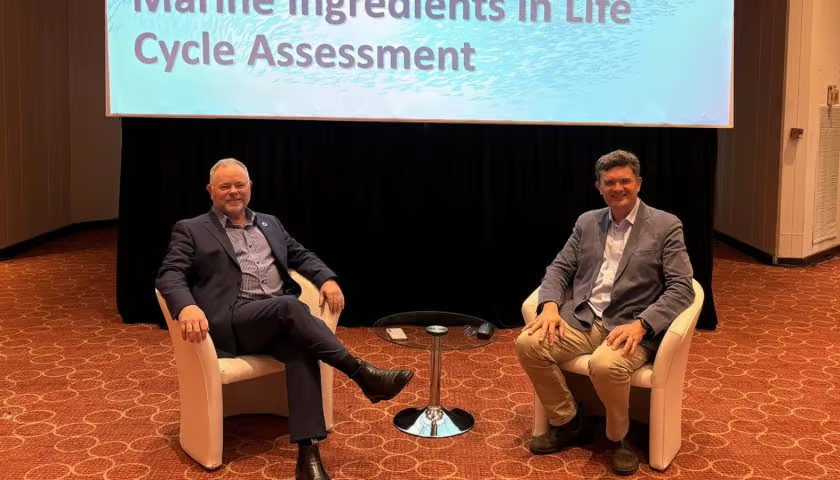
Speaking at IFFO’s Annual Conference in Buenos Aires, Argentina, from 19 to 21 October, the experts urged feed manufacturers to assess the footprint of complete feed formulations instead of relying on individual ingredients or single sustainability indicators.
Dave Robb, Cargill’s director of sustainability for Aqua Nutrition, and Brett Glencross, IFFO’s technical director, discussed the issue during a session examining marine ingredients in the Global Feed LCA Institute (GFLI) database.
The discussion comes as aquafeed manufacturers adjust formulations in response to changing fishmeal and fish oil supplies.

Although plant-based ingredients have helped reduce reliance on marine resources, their production can introduce other environmental pressures, including land use and water consumption.
“We were going in blind,” Glencross said, describing the industry’s earlier shift towards alternative feed ingredients.
Research examining European aquaculture between 2000 and 2020 illustrates these trade-offs.
Production of major farmed fish species increased from 1.15 million tonnes to 2.17 million tonnes, while overall greenhouse gas emissions rose by 314%, land use by 594% and water consumption by 236%.

Wild fish use declined by 13% over the same period. The study attributed much of the increase in environmental impacts to changes in feed composition and the substitution of marine ingredients with plant-based alternatives.
Life cycle assessment can guide feed formulation
Robb and Glencross argued that indicators such as the fish-in-fish-out ratio and fishery forage dependency ratio cannot independently capture the full environmental impact of aquafeed production.
Instead, life cycle assessment (LCA) examines environmental impacts across multiple stages of a product’s supply chain.
For marine ingredients, this can include fishing, transporting catches ashore, processing, transferring materials to rendering facilities and rendering, depending on the production system.
The researchers compiled 370 datasets covering 52 marine meal and oil products, incorporating information on production volumes, processing yields, energy use and water consumption.
The data showed that environmental footprints can vary substantially according to species, raw material, facility and origin.
Ingredients made from processing by-products can have a lower calculated footprint than those produced from whole fish, depending on the system assessed.
For feed manufacturers, these differences matter when comparing ingredients and reformulating diets. Changes must account for nutritional requirements, feed costs and animal performance alongside environmental impacts.
A formulation that costs more per tonne could still improve production efficiency if it supports better fish growth or health.
The speakers acknowledged that LCA still has limitations, including gaps in available data and differences between production systems.
However, they argued that consistent, transparent data can help the aquaculture industry make better-informed sourcing decisions and identify opportunities to reduce the environmental footprint of feed.
The session highlighted the need for stronger industry collaboration and primary data collection to improve sustainability assessments as aquaculture expands.
Sign up HERE to receive our email newsletters with the latest news updates and insights from Africa and the World, and follow us on our WhatsApp channel for updates.


Be the first to leave a comment