

African Union endorses 10-year fisheries and aquaculture programme
The plan targets barriers to aquaculture growth, including limited access to feed, seed, technology and finance, while prioritising investment and stronger regional coordination.
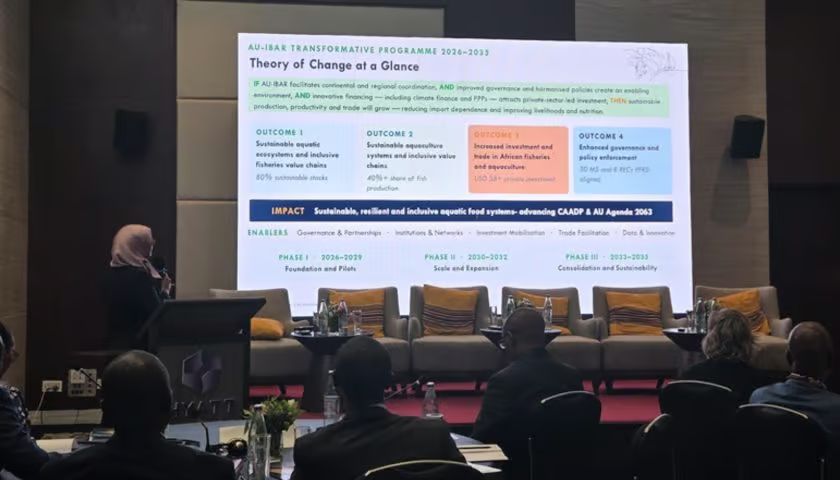
ADDIS ABABA – African Union ministers have endorsed a 10-year programme to transform fisheries and aquaculture between 2026 and 2035, with priorities including improved access to aquaculture inputs, stronger fish value chains, and more sustainable aquatic resources.
AU-IBAR Director Dr Huyam Salih presented the Ten-Year Transformative Programme for Resilient and Sustainable Fisheries and Aquaculture at the closing meeting of the second Fisheries Governance Project (FishGov2).
The endorsement marks the next phase of continental efforts to strengthen the sector, following two successive European Union-supported programmes.
The new programme addresses persistent constraints affecting African fisheries and aquaculture, including degraded aquatic ecosystems, illegal, unreported and unregulated fishing, weak governance of small-scale fisheries, high post-harvest losses and limited access to finance.

In aquaculture, restricted access to quality seed, feed and technology remains a barrier to production growth.
The programme sets out four main outcomes: conserving aquatic ecosystems and improving the sustainability of capture fisheries; addressing constraints on aquaculture production; strengthening fish trade and value chains; and improving governance and policy enforcement.
Implementation will be divided into three phases, covering 2026–2029, 2030–2032, and 2033–2035.
Resource mobilisation for the first phase is under way, with two investment concept notes prepared with support from the African Union Development Agency-NEPAD to guide work on capture fisheries and aquaculture.

Salih said the programme builds on reforms initiated under FishGov (2014 to 2018) and FishGov2 (2021 to 2026).
Both were guided by the African Union’s Policy Framework and Reform Strategy for Fisheries and Aquaculture, which addresses sustainable resource use, aquaculture development, fish trade, small-scale fisheries and regional cooperation.
The programme will rely on Regional Economic Communities to coordinate implementation, with national governments and private-sector actors responsible for delivering activities.
AU-IBAR will facilitate and coordinate the process, while monitoring progress through the existing Comprehensive Africa Agriculture Development Programme Biennial Review to avoid duplicating reporting requirements.
Financing will combine domestic government resources with partner contributions, including potential climate finance and private investment.
Salih called for stronger evidence of the sector’s economic and social value to attract investors, highlighting the need to demonstrate expected returns.
She also urged partners to support a possible third phase of FishGov and maintain progress achieved under the existing programme as the new framework moves towards implementation.
Sign up HERE to receive our email newsletters with the latest news updates and insights from Africa and the World, and follow us on our WhatsApp channel for updates.

Be the first to leave a comment