

Novonesis hosts Algiecel’s microalgae facility in Denmark
The Kalundborg facility expands production capacity nearly fivefold to support the development of alternative marine ingredients for pet food and cosmetics.
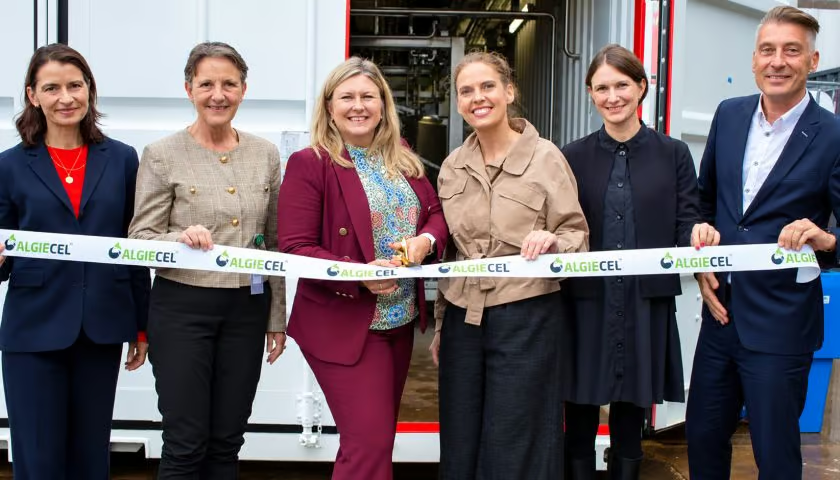
DENMARK – Novonesis is hosting a new microalgae production facility at its Kalundborg site, operated by Danish ingredients company Algiecel, to support scaling up algae-derived ingredients for pet food and cosmetics as pressure grows on fish oil supply.
The facility marks Algiecel’s transition from pilot-scale testing to industrial production, using captured carbon dioxide (CO₂) from an operational biogas plant as an input for microalgae cultivation.
The new reactor has a total volume of 5,500 litres, including 3,240 litres dedicated to active microalgae cultivation, compared with 700 litres in Algiecel’s previous pilot system. This is a nearly fivefold increase in production capacity.
The system uses modular units that can be replicated to expand capacity as demand grows, without redesigning the entire production process.

Using CO₂ captured from an operating biogas plant also allows Algiecel to demonstrate its technology with industrial inputs.
Ghita Hansen, Vice President of Enzyme Production Denmark at Novonesis, said the facility shows how companies can use shared infrastructure, industrial expertise, and side-streams to accelerate new technology development.
“Kalundborg shows what happens when companies work together to get more value from shared infrastructure, side-streams and industrial expertise,” Hansen said.
Alternative to fish-derived ingredients

The facility comes as fish oil supply faces pressure from fluctuations in wild-catch production and climate-related factors.
Algiecel cites data from the marine ingredients organisation IFFO, which indicates that cumulative fish oil supply across major producing regions was about 31% below 2025 year-to-date levels by early June 2026.
Fish oil is an important source of omega-3 fatty acids in pet food and is used in cosmetic formulations, making alternative sources relevant to manufacturers seeking more predictable ingredient supplies.
Algiecel’s technology produces microalgae biomass under controlled conditions, offering a potential alternative that doesn’t rely on wild-caught fish.
The company expects to produce 12 tonnes of biomass annually from 2027 and targets the pet food and cosmetics industries.
Preparing for commercial production
The facility follows a DKK 60 million (approximately US$8.7 million) funding round Algiecel completed in 2024, supporting its move toward commercial operations.
Algiecel Chief Executive Officer Susanne Palsten Buchardt said the company had operated its pilot reactor for more than 10,000 hours, providing a foundation for scaling production under industrial conditions.
The company has also strengthened its leadership team ahead of commercialisation.
Tove Feld, former technology and engineering executive at Ørsted and Siemens Wind Power, was appointed Chair of the Board, while Mette Ingeman Pedersen, formerly CFO of Topsoe’s Power-to-X business, joined as Chief Financial Officer.
For Novonesis, the project highlights the potential of industrial collaboration to support the development and scale-up of biosolutions by using existing infrastructure and industrial side-streams.
Sign up HERE to receive our email newsletters with the latest news updates and insights from Africa and the World, and follow us on our WhatsApp channel for updates.


Be the first to leave a comment